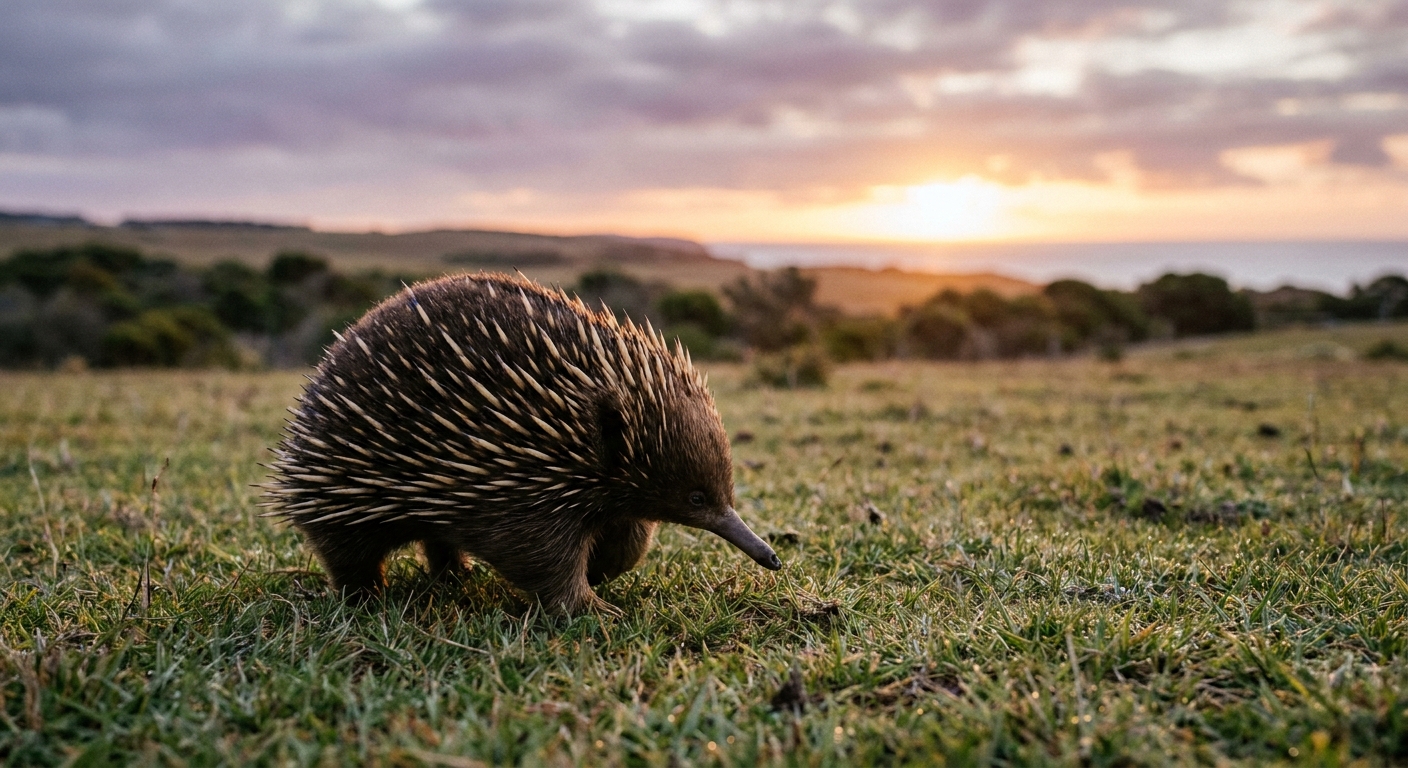
Every so often a guest at Zoarii calls the house to ask what on earth is crossing the paddock. It is round, it is covered in spines, it moves like a wind up toy and it will not be hurried. That is a short-beaked echidna, and it is one of the strangest animals alive: a mammal that lays eggs, a relative of the platypus, and a Phillip Island local that treats our 3.5 acres as a buffet.
What exactly is an echidna?
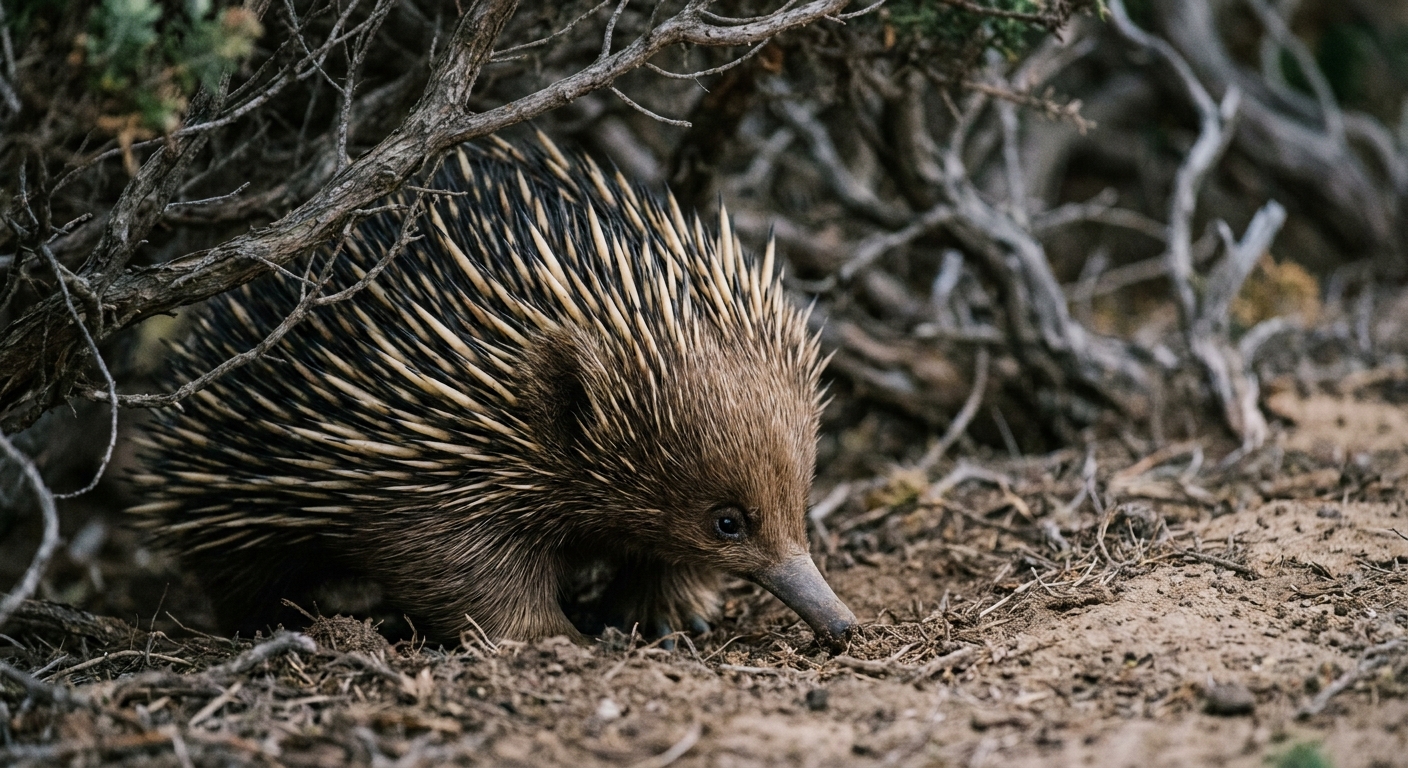
The short-beaked echidna (Tachyglossus aculeatus) is a monotreme, one of only a handful of mammals on the planet that lay eggs rather than give birth to live young. It has a rounded body about the size of a football covered in cream tipped spines, which are really modified hairs, a long thin snout, and strong clawed feet built for digging. It eats ants, termites and other invertebrates, hoovering them up with a sticky tongue, and its snout can detect the faint electrical signals of its prey in the soil.
The egg, the puggle and the pouch
The female lays a single soft shelled egg and tucks it into a temporary pouch on her belly, where it hatches about ten days later. The hatchling, called a puggle, is tiny, blind and hairless, and it feeds on milk that the mother secretes through patches of skin because echidnas have no nipples. Once the puggle starts to grow spines, understandably, it is moved out of the pouch and into a burrow. There is no other childhood on Earth quite like it.
Slow, spiky and very long lived
Echidnas run a low body temperature and a slow metabolism, and they can live for decades, with some recorded past forty five years. In winter and early spring the males form what locals call echidna trains, a line of hopeful suitors trailing a single female across the paddocks for days. When threatened an echidna simply digs straight down and leaves only a ball of spines showing, which on a fox free island like this one it rarely needs to do.
Where to see them on Phillip Island
Everywhere, eventually. Echidnas turn up in paddocks, roadside verges, dunes and bushland across the island, most often in the cooler parts of the day and especially through winter and spring when the trains form. Drive slowly, and if you meet one on foot, stand still and let it decide. It will usually carry on foraging within a minute or two once it is sure you are just scenery.
Fast facts for your stay
- One of the very few egg laying mammals on Earth, related to the platypus.
- Spines are modified hairs; beneath them is a coat of brown fur.
- The snout can sense the faint electrical signals of insects underground.
- Lays one egg into a temporary pouch; the hatchling is called a puggle.
- Mothers have no nipples and feed milk through patches of skin.
- Can live for decades, with records beyond forty five years.
- Males follow females in echidna trains during winter and spring.
- Never pick one up: stand still and let it carry on.
Seeing them from Zoarii
Zoarii sits on 3.5 acres above Berrys Beach and the echidnas treat the paddocks as their own. The trick is patience: a coffee on the deck in the cool of the morning, or the last light before the sauna, and sooner or later a spiky football will trundle out of the scrub and start excavating the lawn. Wildlife watching does not get more comfortable, or more peculiar.
Part of our Island Nature series, after the Cape Barren geese, swamp wallaby, little penguins, short-tailed shearwaters, Australian fur seals, hooded plovers, koalas. Next: the pelicans of San Remo and their daily lunch.
Two bedrooms, private sauna, cold plunge and 3.5 acres above Berrys Beach.