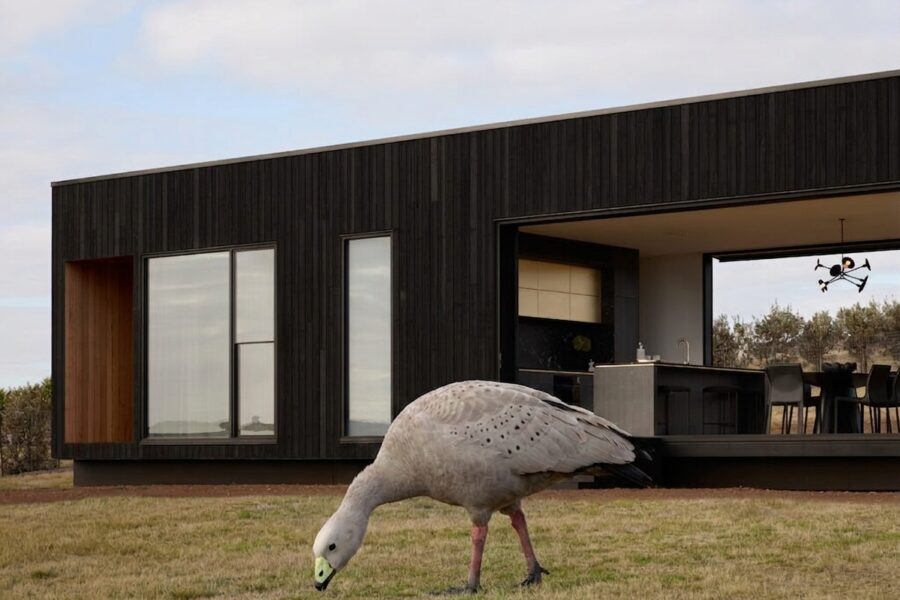
Just before the light goes each evening, the paddock edges at Zoarii change shift. The geese clock off, the shadows stretch, and a small dark shape appears at the tree line, nose down, working its way along the fence with the caution of an animal that prefers not to be noticed. Meet the swamp wallaby, Phillip Island’s shy local, and the best reason to keep the fire going a little longer.
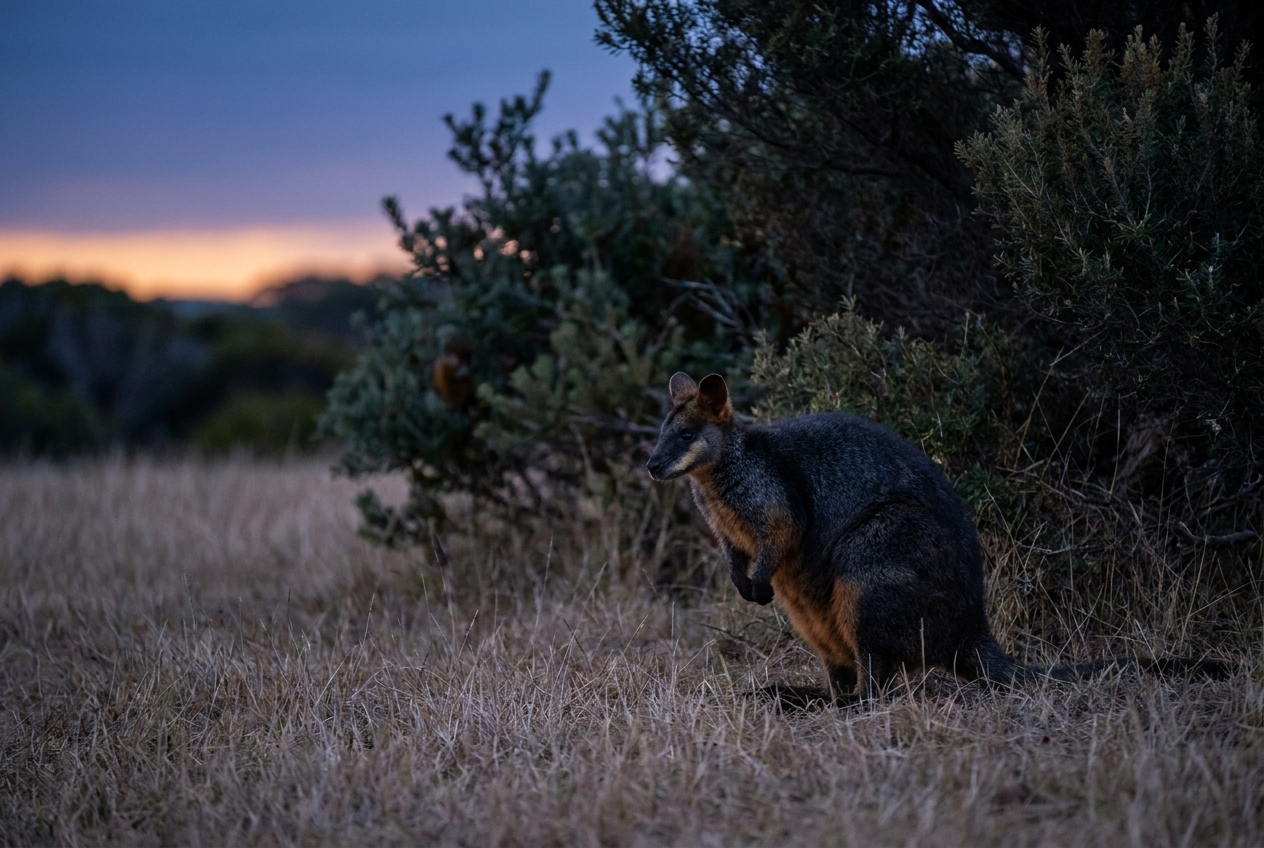
What exactly is a swamp wallaby?
The swamp wallaby (Wallabia bicolor) is a stocky, mid-sized wallaby with a coat unlike any other macropod: deep charcoal to black across the back, a rich rusty orange chest and belly, and a pale stripe along the cheek that looks hand painted. Old timers called it the black wallaby, and it moves differently too, head low and tail flat, more like a creature slipping between rooms than bounding across a plain.
The loner of the family tree
Like the Cape Barren goose we wrote about last time, the swamp wallaby sits entirely alone on its branch of the family tree. It is the only living member of its genus, and it does not even share a chromosome count with the wallabies it is named after. Phillip Island seems to collect these evolutionary loners, animals odd enough that science had to give them a genus of their own, and they all seem entirely comfortable about it.
The animal that is always expecting
Here is the fact to save for dinner at the island winery: research has shown that female swamp wallabies can conceive their next joey a day or two before the current one is even born. Between overlapping pregnancies and a paused embryo held in reserve, an adult female can be, in effect, continuously pregnant for her entire adult life. No other mammal on Earth is known to live this way. She does all of this while raising a joey in the pouch and still making it to your fence line by dusk, which puts most of our schedules into perspective.
An island where shy animals relax
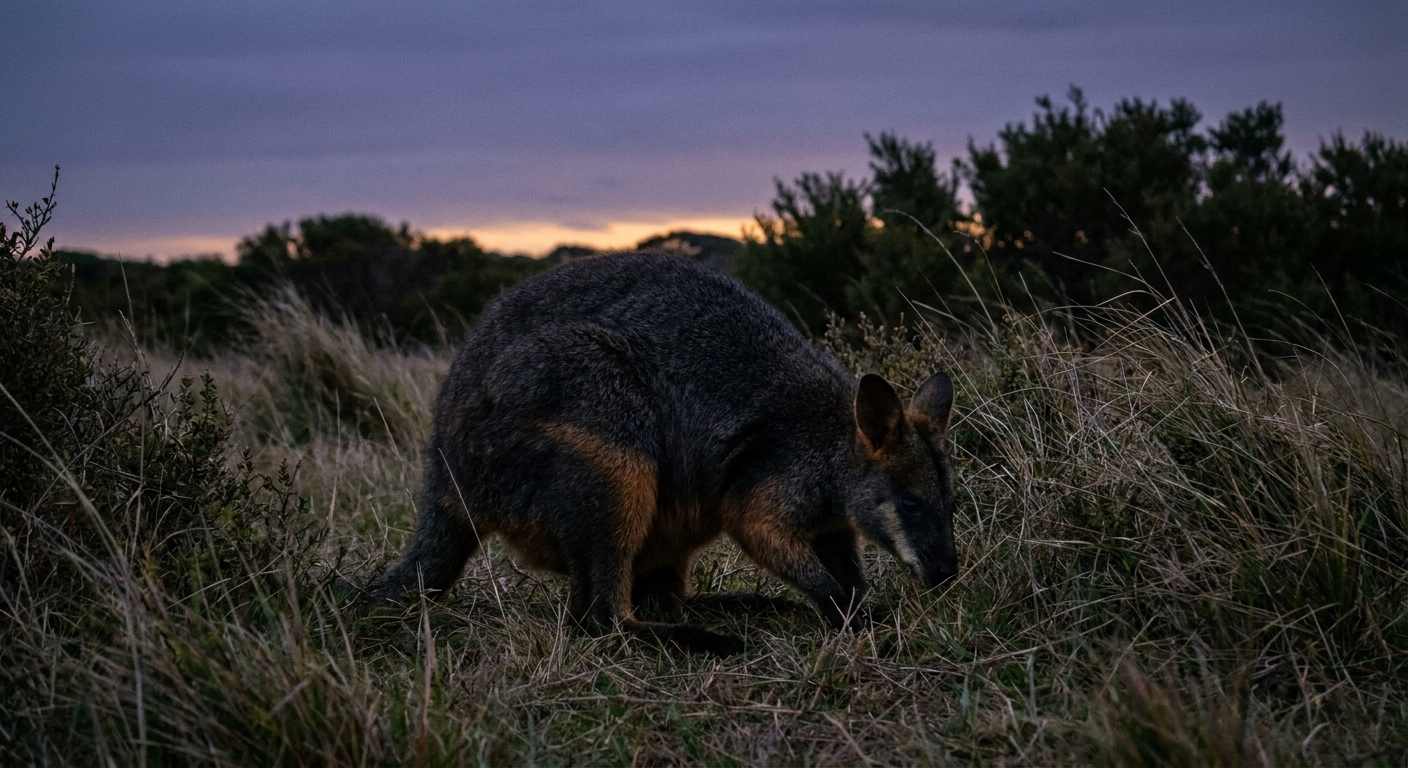
Phillip Island was declared fox free after a decades long eradication program, and nothing here hunts a healthy adult wallaby. On the mainland a swamp wallaby is a rumour you glimpse for two seconds. On the island, with nothing to fear, they browse the paddock margins in the open through dusk and dawn, and a quiet observer on a deck with a drink is treated as scenery rather than threat.
Where to see them on Phillip Island
Dusk and dawn are the hours. The Oswin Roberts Reserve and the bush tracks around Rhyll are reliable, the Cape Woolamai walks turn them up in the banksia scrub, and any quiet road through farmland deserves a slow drive at last light. They are browsers rather than grazers, so look along edges where paddock meets scrub, not out in the open like the geese.
Fast facts for your stay
- The only living member of its genus, a true evolutionary loner.
- Its chromosome count differs from every other wallaby, a puzzle that helped earn it a genus of its own.
- Females can conceive before giving birth and may be continuously pregnant their whole adult lives, unique among mammals.
- A browser, not a grazer: it eats shrubs, ferns and leaves other animals avoid, including bracken.
- Mostly solitary, unlike the mobs kangaroos form.
- Active at dusk and dawn, with the fox free island making it far bolder here than on the mainland.
- Please never feed them, and give a browsing wallaby the path; it was here first.
Seeing them from Zoarii
Zoarii sits on 3.5 acres above Berrys Beach with paddock edges the wallabies treat as their evening corridor. The move is simple: sauna as the sun drops, then something warm in hand by the fire, eyes on the fence line. The geese take the day shift and the wallabies take the evening one, and between them the paddock is never really empty. Wildlife watching does not get more comfortable.
This is the second in our Island Nature series, after the Cape Barren geese. Next: the short-tailed shearwaters, whose evening return over the ocean is one of the great wildlife spectacles in Australia.
Two bedrooms, private sauna, cold plunge and 3.5 acres above Berrys Beach.