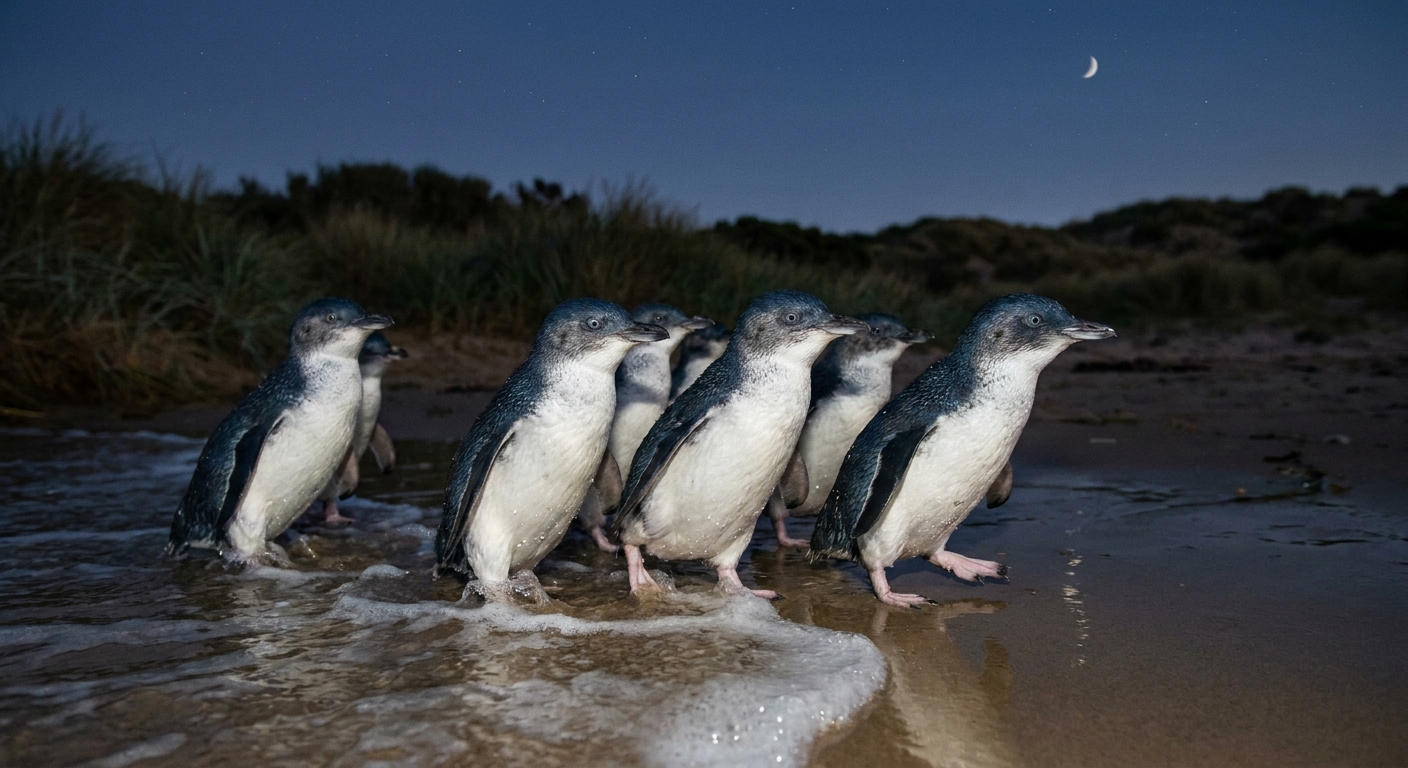
Every evening of the year, as the last light leaves the water off Summerland Beach, the smallest penguins in the world come home from work. They arrive in little rafts just beyond the break, wait for the courage of numbers, then waddle up the sand in nervous, determined groups and disappear into the dunes. It has been happening on Phillip Island for longer than anyone has been watching, and it is still the most quietly moving thing you can see in Victoria.
What exactly is a little penguin?
The little penguin (Eudyptula minor) is the smallest penguin on Earth, standing about 33 centimetres tall and weighing roughly a kilogram, about the same as a bag of sugar. Older locals still call them fairy penguins. Up close they are not black and white at all but a deep slate indigo blue on the back with a white front, pale silvery-grey eyes and pink feet. Phillip Island is home to around 40,000 of them, one of the largest colonies anywhere, and the reason a small island in Bass Strait is known around the world.
The island that gave a suburb back
Here is the story that says everything about this place. In the 1980s the Summerland Peninsula, where the penguins breed, was a housing estate. The colony was in trouble, so Victoria did something almost unheard of: it bought back the entire estate, house by house, and returned the land to the penguins. It took twenty five years, from 1985 to 2010, and around 180 houses came down so 774 blocks could go back to the birds, and it worked. The penguin population recovered and the parade you can watch tonight exists because a community decided the birds were worth more than the blocks. Phillip Island takes its wildlife seriously, and this is the proof.
Smallest penguin, biggest commute
A little penguin leaves its burrow before dawn and can swim tens of kilometres out into Bass Strait for the day, diving hundreds of times for small fish and squid, sometimes to depths of more than 60 metres. Then it swims all the way back to the same beach, the same dune and the same burrow, and finds it in the dark. During the breeding season a parent does this while a chick waits at home for dinner. Every penguin you see stepping out of the surf has just finished a working day most of us would find unreasonable.
Safe on a fox free island
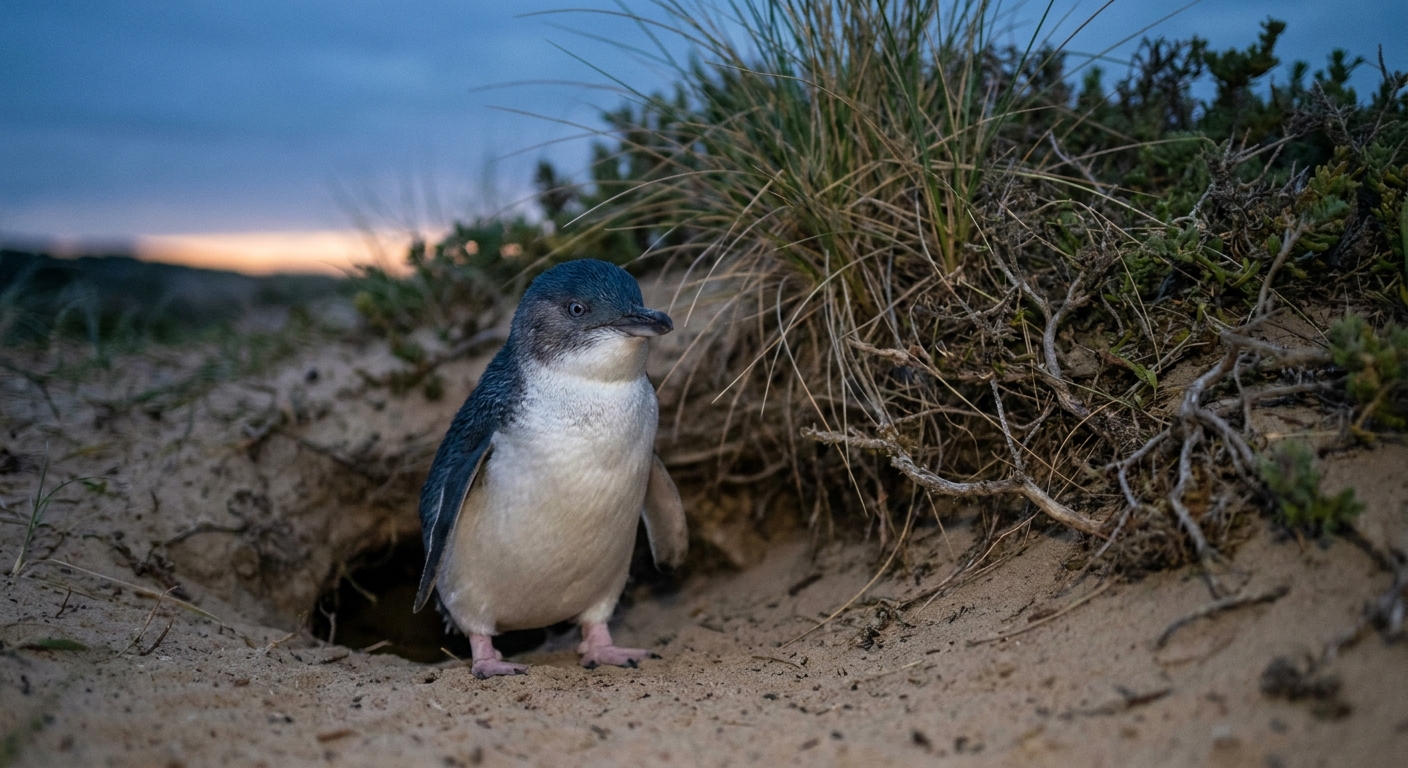
Like every animal in this series, the little penguin owes its ease to one fact: Phillip Island is fox free after a decades long eradication program. Foxes were once the colony’s greatest threat on land. Today the penguins cross the beach in the open, guarded only by darkness and each other, and the population is healthy enough that the island has become the place the rest of the world comes to see them.
Where to see them on Phillip Island
The Penguin Parade at Summerland Beach is the classic, and rightly so. Book ahead because it sells out, arrive before sunset, rug up because the wind comes straight off the Strait, and never use a flash. The Nobbies boardwalks nearby reveal penguins in their burrows at dusk, and in summer you may hear them calling from the dunes long after dark. It is about a fifteen minute drive from Zoarii, which makes the timing perfect: parade, then home to the fire.
Fast facts for your stay
- The smallest penguin species on Earth, about 33 cm tall and around a kilogram.
- Phillip Island’s colony numbers around 40,000 birds.
- They come ashore only after dark, in groups called rafts, for safety in numbers.
- They can dive to more than 60 metres and make hundreds of dives in a day at sea.
- Both parents share the chick raising, swapping fishing shifts.
- Each year they moult for two to three weeks and cannot swim, living off stored fat until the new feathers grow.
- A whole housing estate, around 180 houses on 774 blocks, was bought back between 1985 and 2010 to protect them.
- No flash photography, ever. Their eyes are built for the dark.
Seeing them from Zoarii
Zoarii sits on 3.5 acres above Berrys Beach, fifteen minutes from the parade. The ideal evening writes itself: sauna in the late afternoon, drive to Summerland for sunset and the penguins, then back to the house for a late dinner by the fire with the whole island dark and quiet around you. Wildlife watching does not get more comfortable.
This is the third in our Island Nature series, after the Cape Barren geese and the swamp wallaby. Next: the short-tailed shearwaters, whose evening return over the ocean is one of the great wildlife spectacles in Australia.
Two bedrooms, private sauna, cold plunge and 3.5 acres above Berrys Beach.